
The Owner’s Representative Role in Building Restoration vs. New Construction
Updated: Sep 16
An Owner’s Representative plays an important role in protecting the owner’s interests throughout a construction project. However, managing a new construction project and managing the restoration of an existing condominium are very different challenges.
In new construction, the project typically begins with a defined design, a new structure, and a planned sequence of work. In building restoration, the project team is working with an existing structure, occupied spaces, aging materials, previous repairs, and conditions that may not become fully visible until construction begins.
For condominium associations, these differences can significantly change the role of the Owner’s Representative.

The Owner’s Representative Role in Building Restoration: Managing Unknown Conditions
One of the biggest differences between restoration and new construction is the level of uncertainty associated with existing conditions.
Drawings, inspections, testing, and engineering reports provide important information before construction begins, but they cannot always identify every condition hidden within an existing building.
Once concrete demolition, waterproofing removal, window replacement, roofing work, or other restoration activities begin, actual field conditions may differ from what was anticipated.
Additional deterioration may be discovered. Existing utilities may conflict with proposed repairs. Previous repairs may not match available drawings. A condition affecting one trade may require modifications to another scope of work.
When this happens, the Association needs more than a contractor’s proposal for additional work.
The project team needs to determine:
Is the additional work already included in the original contract?
Is it covered by an allowance or unit price?
Does the condition require additional engineering or design?
What documentation supports the proposed cost?
Does it affect another contractor or scope of work?
Does the condition actually affect the project schedule?
The Owner’s Representative helps coordinate these questions between the Association, Engineer, Architect, contractor, Property Manager, and other project participants.
BRS Field Example
During restoration of an existing condominium amenity area, a structural condition conflicted with an existing building system. The issue required coordination between the contractor, design professionals and Association before the affected work could proceed.
Physical Progress and Financial Progress Are Not Always the Same
A common mistake in large restoration projects is assuming that the percentage paid to the contractor represents the percentage of construction physically completed.
The two numbers are not necessarily the same.
A contractor’s payment application may include mobilization, stored materials, approved Change Orders, General Conditions, or other contractual items that do not translate directly into visible construction progress.
For this reason, an Owner’s Representative should evaluate the project from two different perspectives:
Financial Progress – How much of the contract has been billed and paid?
Physical Progress – How much of the actual construction work has been completed?
Tracking both provides the Board and Property Manager with a clearer understanding of the actual status of the project.
BRS Field Example
On major condominium restoration projects, BRS tracks financial and physical progress separately.
A difference between these percentages does not automatically mean there is a problem. However, a significant difference should be understood and supported before the Association relies on the percentage paid as an indication of overall project completion.
This distinction becomes particularly important when Boards are evaluating project cash flow, contractor payment applications, remaining contract balances, and anticipated completion.
Change Orders Require More Than a Price Review
Change Orders are common in restoration projects because existing conditions cannot always be completely identified before construction.
However, reviewing a Change Order should involve more than determining whether the contractor’s proposed price appears reasonable.
Before approving additional work, the Association and project team should understand:
Why is the additional work necessary?
Is the work already included elsewhere in the contract?
Are quantities supported by field measurements or other documentation?
Are contract allowances or unit prices applicable?
Does the work require engineering or design revisions?
Does it affect another contractor or scope?
Is additional Contract Time being requested?
If additional time is requested, what is the documented impact on the project schedule?
Cost and time should be evaluated independently.
The fact that additional work has a cost does not automatically establish that the project completion date should be extended.
The Owner’s Representative helps the Association coordinate the technical, contractual, financial, and scheduling information necessary to evaluate the request.
BRS Field Example
During restoration of an existing condominium amenity area, a structural condition conflicted with an existing building system. The issue required coordination between the contractor, design professionals, and Association before the affected work could proceed. Identifying the conflict before continuing the work helped the project team evaluate the required design modification and its potential cost and schedule impact.
Schedule Management Is More Than Comparing Dates
Restoration schedules can be affected by many factors, including inspections, design clarifications, access restrictions, weather, material deliveries, unforeseen conditions, Change Orders, permitting, and coordination between multiple contractors.
Because of this complexity, evaluating a request for additional Contract Time requires more than counting the number of days between two events.
For example, an issue may remain unresolved for 20 days without delaying the work controlling the project’s completion for all 20 days.
The more important question is:
How did the event actually affect the project schedule and completion?
An Owner’s Representative should help document significant project events and coordinate the review of schedule impacts with the contractor, Engineer, Architect, and other appropriate project professionals.
This provides the Association with better information when evaluating requests for additional time and potential changes to the contractual completion date.
Coordination Between Trades Is Critical
Major condominium restoration projects frequently involve several contractors, consultants, and overlapping scopes of work.
Concrete restoration may affect waterproofing.
Waterproofing elevations may affect railings, doors, or thresholds.
Window replacement may interact with existing partitions and interior finishes.
Structural repairs may conflict with plumbing, electrical, or other existing systems.
Roofing work may affect drainage or mechanical equipment.
A decision made within one scope can therefore create additional costs, design requirements, or schedule impacts somewhere else.
Each contractor naturally focuses on its own contractual scope. The Engineer and Architect have their respective professional responsibilities. The Property Manager has the ongoing responsibility of operating the property.
The Owner’s Representative helps the Association look at these issues from the perspective of the overall project and coordinates communication between the different parties.
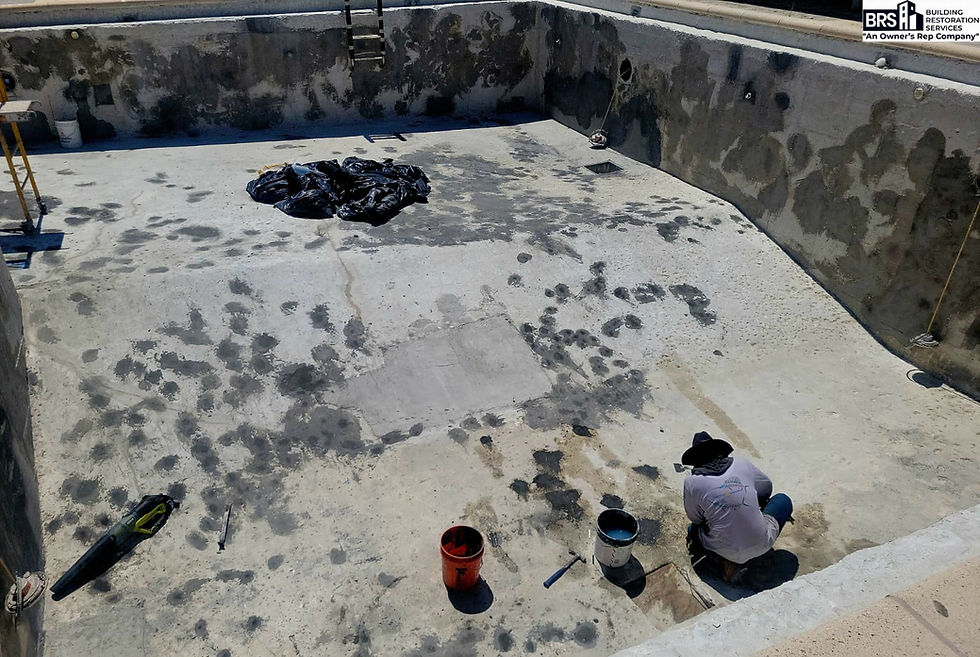
A Simple Example: Pool Deck Restoration
Consider a condominium restoring an existing pool deck.
The existing perimeter railing may need to be temporarily removed so concrete repairs and waterproofing can proceed.
During reconstruction, changes to the finished deck elevation—or previously unidentified conditions involving the existing railing—may affect whether the original system can be reinstalled in compliance with the applicable requirements.
If this issue is discovered only when the contractor attempts to reinstall the railing, the project may require additional evaluation, modifications, or design work that could affect cost and schedule.
An experienced project team should evaluate these interfaces as early as reasonably possible rather than waiting until they become close-out problems.
This is a simple example of why restoration management requires looking beyond the individual activity currently under construction.
Occupied Buildings Add Another Layer of Complexity
Unlike most new construction projects, condominium restoration frequently takes place while the building remains occupied and operational.
Residents still need access to their homes. Property Management must continue operating the building. Contractors may need access to individual units. Parking areas, elevators, balconies, amenities, walkways, and other common areas may be temporarily affected.
Construction activities may also create noise, dust, temporary closures, or changes to normal circulation around the property.
For that reason, communication and phasing become important components of project management.
The Owner’s Representative helps coordinate construction activities with the Property Manager and project team so the Association understands upcoming work and can communicate relevant information to residents.
Building Restoration vs. New Construction
An Owner’s Representative in new construction typically helps manage the project from design and procurement through construction, commissioning, and turnover.
Typical responsibilities may include:
Design coordination
Budget review
Procurement and contractor selection
Schedule monitoring
Construction progress reviews
Payment application review
Change management
Quality observations
Close-out and turnover
Many of these responsibilities also exist in restoration.
The major difference is that restoration requires the project team to continuously reconcile the design and contract documents with an existing building and the conditions discovered during construction.
For condominium associations, the building may also remain occupied throughout much of the work.
That combination of existing conditions, construction uncertainty, resident coordination, multiple trades, and ongoing building operations can make restoration project management particularly complex.
What Should a Condominium Board Expect From Its Owner’s Representative?
The purpose of an Owner’s Representative is not to replace the Engineer of Record, Architect, contractor, or Property Manager.
Each party has a different role and contractual responsibility.
Instead, the Owner’s Representative works on behalf of the owner or Association to coordinate across those roles and provide the Board with the information necessary to make informed project decisions.
Depending on the project, this may include providing visibility into:
Construction progress
Financial progress
Contractor payment applications
Change Orders
Contract allowances
Project schedule
Pending decisions
Contractor and consultant coordination
Permitting and inspections
Potential cost and schedule risks
Resident and Property Management coordination
Project close-out
For a condominium Board, the objective should be straightforward:
Understand what has been completed, what has been paid, what decisions are pending, what risks exist, and what needs to happen next.
A good Owner’s Representative helps make that information clear.
BRS Owner’s Representation for South Florida Condominiums
BRS Building Restoration Services provides Owner’s Representative and Construction Project Management services for condominium restoration, recertification, and capital improvement projects throughout South Florida.
Our approach focuses on providing Boards and Property Managers with clear visibility into project scope, construction progress, financial status, Change Orders, schedule, coordination, and close-out.
BRS supports condominium projects involving structural and concrete restoration, façade repairs, waterproofing, glazing and window replacement, roofing, pool and deck restoration, building recertification, and other major capital improvements.
Serving condominium associations throughout Miami-Dade, Broward, and Palm Beach Counties.


Comments